Study Hub
✈ Study Materials
Study Hub
Everything you need to prepare for your ICAO ELP test — organized by question type. All materials are built from real exam reports submitted by pilots. The skills you practise here — picture description, non-routine narration and examiner Q&A — apply to the TEA, ELPAC and national ICAO exams worldwide. See our guide to ICAO aviation English tests →
Free 1–2
Trial 3–4
Premium unlocks 2 more each month
Taxiway Collision — Aircraft Wing Strike During Evening Operations
📖 Scene Description
An evening airport scene. A large aircraft has taxied off the centreline and collided with the tail of a smaller aircraft. Fire trucks and ambulances are standing by nearby. Fireworks are visible in the background sky. One aircraft is stationary at the centre of the scene. Passengers at windows of the large aircraft appear surprised.
💬 Examiner Q&A
1Would the pilot notice a wingtip collision during taxi? How would you communicate with ground personnel?
Noticing a wingtip contact during taxi is difficult as the wingtips are far from the cockpit and not directly visible. A strong vibration or thud might be felt. Communication with ground personnel would be via radio, and a wing walker or ramp crew would be called to confirm the extent of any contact.
2Of fireworks, airships, and birds — which poses the greatest threat to aircraft?
Birds generally pose the greatest operational threat due to their prevalence around airports and the risk of engine ingestion. However, fireworks present a specific hazard during evening operations, particularly to low-flying aircraft during approach and departure. Information on firework events is available in NOTAMs.
3Can a setting sun affect takeoff and landing safety?
Yes. A low sun at certain angles — particularly on east-west runways at sunrise or sunset — can cause severe glare that reduces runway visibility and makes visual reference difficult. Pilots may request a different runway or delay takeoff timing. Sun visors and appropriate approach briefings are important mitigations.
4Where can firework event information be obtained?
NOTAMs (Notice to Air Missions) are the primary source. Firework events near airports are notified in advance with details of location, altitude, and duration. Flight crews should review NOTAMs during pre-flight planning for any events that may affect their route or airspace.
Key Vocabulary
Wing strikeTaxiway centrelineNOTAMWing walkerGround collisionFirework hazard
Earthquake at Airport — Runway Damage, Aircraft Directed to Go-Around
FreeEarthquake at Airport — Runway Damage, Aircraft Directed to Go-Around
📖 Scene Description
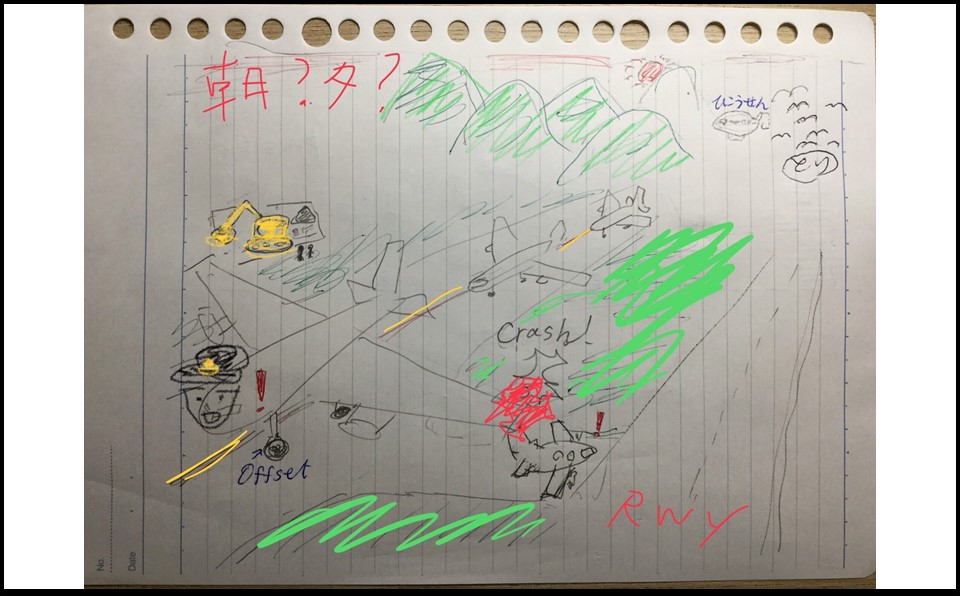
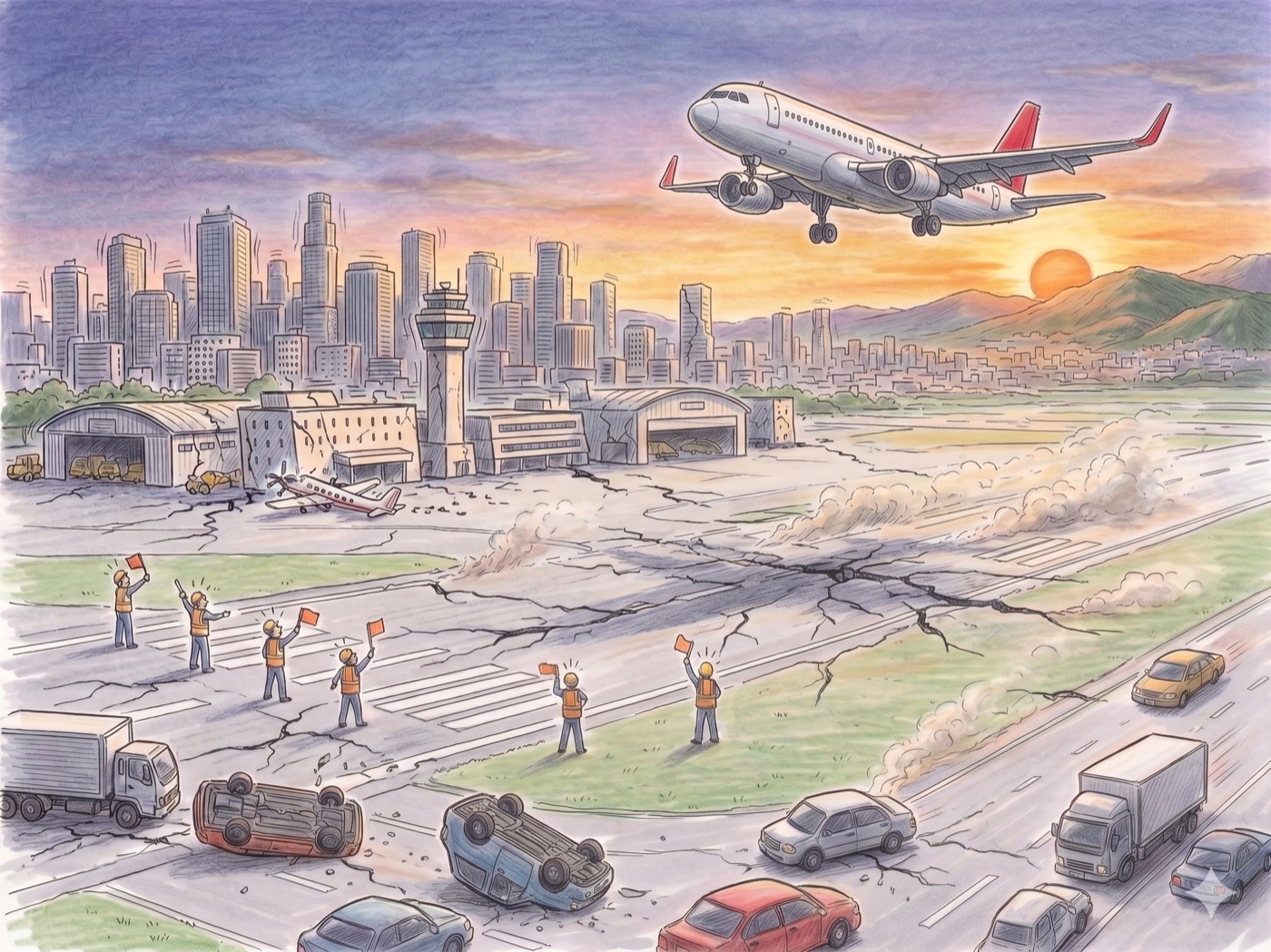
A large airport viewed from a distance, with a city skyline in the background. Tall buildings are visibly shaking. Cars are overturned on roads nearby. The runway and ramp surfaces show visible cracks and damage. One aircraft is on approach but being waved off — told to go around due to runway damage.
💬 Examiner Q&A
1If you are the go-around aircraft, what will you do next?
I would follow the published missed approach procedure, enter a holding pattern, and request ATC updates on the situation. I would assess fuel state, identify alternate airports, and request diversion clearance if the runway at the destination cannot be quickly confirmed safe. Communication with company dispatch is also important.
2Can you land on a cracked runway?
No — we cannot land until the runway has been inspected and declared safe by airport operations. Landing on a cracked surface could cause tire bursts, directional control loss, or structural damage to the aircraft. Safety of the landing surface must be confirmed before any landing attempt.
3If the earthquake occurs at night with a power outage, what happens?
Runway lights would go dark, making visual approaches extremely difficult or impossible. ILS, VOR, and other radio navigation aids may also fail. In such a scenario, I would not attempt an approach without confirmed positive contact from the airport. Diversion to an unaffected airport becomes the priority.
4If this happened at Haneda, where would you divert?
I would consider airports outside the earthquake’s affected zone — Kansai (RJBB) or Chubu (RJGG) are likely candidates for a 787, as our range easily reaches them from the Tokyo area. The final decision depends on the extent of the earthquake, fuel state, and ATC guidance.
Key Vocabulary
Runway inspectionGo-aroundAlternate airportDiversionRunway serviceabilityPower outage
Hydraulic Fluid Leak — Pre-Departure, MEL Discussion
TrialTire Burst — Runway Overrun on Snow-Covered Mountain Airport
TrialPre-Departure Pushback — Cockpit Preparation and Ramp Operations
🔒 Premium · month 1Local Airport Approach — Crosswind, Headwind and Tailwind Effects
🔒 Premium · month 1Spot-in Operations — Marshaller Guidance and VDGS
🔒 Premium · month 2Winter Operations — De-icing and Contaminated Ramp Conditions
🔒 Premium · month 2Pre-Flight CA Briefing — Coordination with Cabin Crew
🔒 Premium · month 3Final Approach — Thunderstorm and Windshear Conditions
🔒 Premium · month 3Winter Ramp Operations — De-icing, Refuelling and a Slip Hazard at Dusk
🔒 Premium · month 4Summer Ramp — Approaching Thunderstorm and a Suspended Ramp
🔒 Premium · month 412 scenes · 2 new unlock each month
First Officer Incapacitation — Emergency Declaration & Single-Pilot Diversion
FreeFirst Officer Incapacitation — Emergency Declaration & Single-Pilot Diversion
📖 Scenario
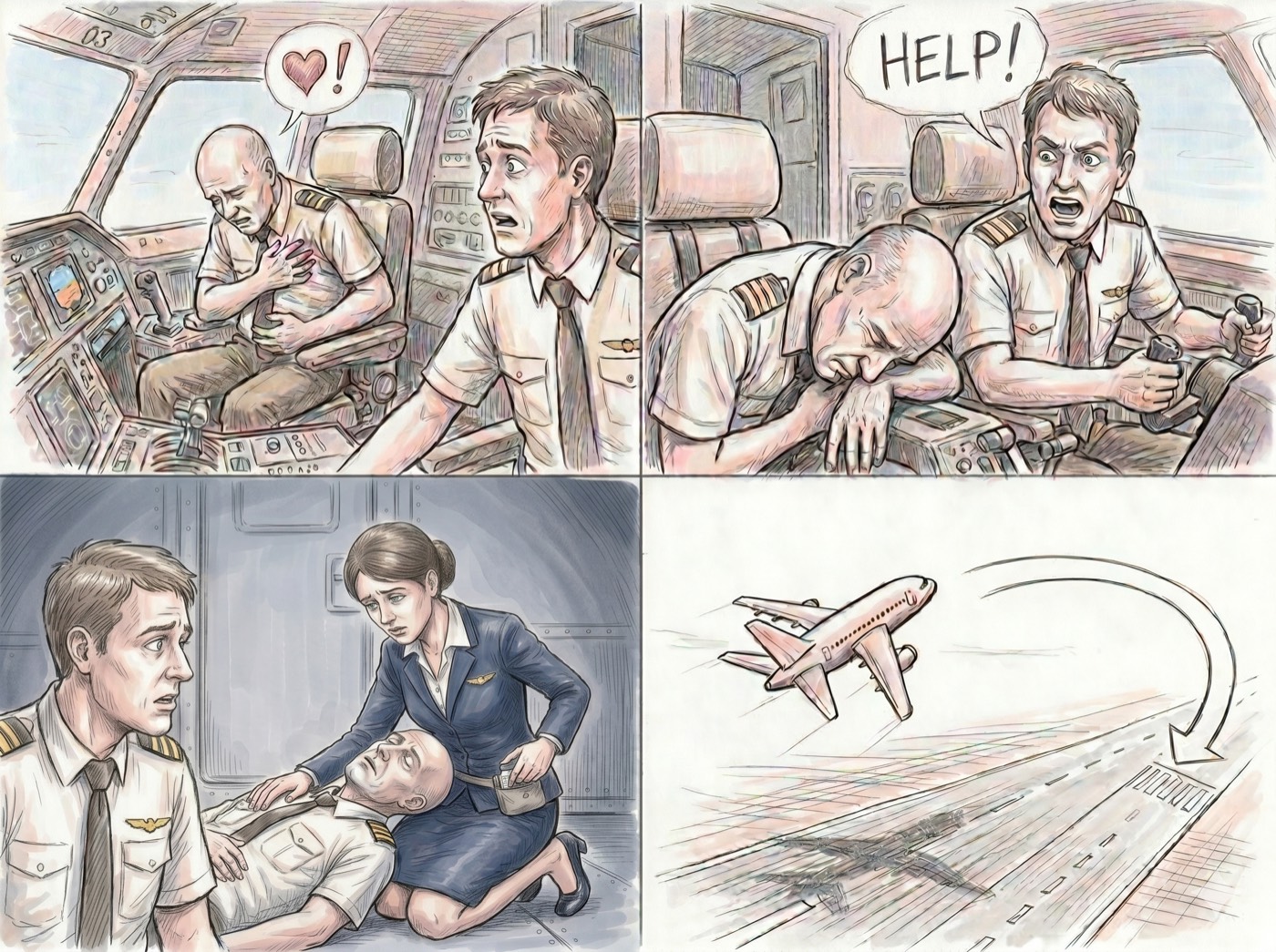
Last week, during cruise at FL350, the First Officer suddenly lost consciousness without warning. I immediately secured the aircraft under my sole control and called for the senior cabin crew member. A passenger who identified as a nurse provided medical assistance at the cockpit entrance. I declared a Mayday, squawked 7700, and diverted to the nearest suitable airport with adequate medical facilities. We landed without incident, and the First Officer was taken to hospital immediately.
Panel 1
First Officer collapses in right seat — Captain takes full sole control of the aircraft.
Panel 2
Captain calls cabin crew — FO unresponsive, medical assistance requested.
Panel 3
Passenger with medical training assists FO at cockpit entrance.
Panel 4
Emergency diversion — Captain lands single-pilot, FO transported to hospital on arrival.
💬 Examiner Q&A
1What is your first action when the First Officer loses consciousness?
Aviate first — I ensure the aircraft is on a safe flight path and the autopilot is engaged. I do not leave the controls. I then call the senior cabin crew member to attend to the FO and request any medically trained passenger to assist at the cockpit entrance.
2How do you declare an emergency as the sole operating pilot?
I transmit “Mayday, Mayday, Mayday” on the current frequency, state my callsign, nature of emergency, souls on board, and fuel state. I squawk 7700. ATC will provide priority handling and coordinate emergency services at the diversion airport.
3How do you manage the approach and landing without a First Officer?
I request a long final and use maximum automation — a coupled ILS approach with autopilot to at least decision altitude where possible. I brief ATC that I am operating single-pilot. Checklist items are completed between ATC calls, and the senior cabin crew member is briefed before descent begins.
4What factors determine your choice of diversion airport?
The FO’s medical condition drives the urgency. I consider proximity, available medical facilities on the ground, runway length, approach aids, and weather. I use the FMS nearest airport function and consult ATC for options. Speed is the priority — the FO needs medical attention as quickly as possible.
5After landing, what are your responsibilities?
I ensure the FO receives immediate medical care and brief the ground medical team on the FO’s condition. I file an Air Safety Report and medical incident report. I notify company operations and remain available for the operator’s investigation. The event will be reviewed for any procedural lessons.
Key Vocabulary
Pilot incapacitationSingle-pilot operationsMayday declarationSquawk 7700Emergency diversionAir Safety Report (ASR)

Snow Removal Delay — Extended Holding & Low Fuel Emergency
FreeSnow Removal Delay — Extended Holding & Low Fuel Emergency
📖 Scenario
Last winter, I was inbound to my destination airport during heavy snowfall. The runway was closed for snow removal operations, and ATC placed us in a holding pattern. After three holding circuits, two other aircraft were also holding. Our fuel reached the low fuel message threshold and I declared an emergency, requesting immediate priority landing. We landed safely, but fuel remaining was below minimum reserve.
Panel 1
Heavy snowfall — runway closed for snow removal vehicles.
Panel 2
Three aircraft holding — extended delay continues.
Panel 3
Low Fuel message triggers — fuel below safe holding margin.
Panel 4
Emergency declared — priority landing approved, aircraft lands safely.
💬 Examiner Q&A
1What is the difference between minimum fuel and emergency fuel?
Minimum fuel means the aircraft can reach its destination but there is no longer a significant reserve — the pilot informs ATC but it is not yet an emergency. Emergency fuel means the aircraft cannot reach its destination without landing priority; this is a Mayday situation. The transition from minimum to emergency depends on fuel consumption rate versus distance to available airfield.
2Could you have avoided this situation?
Yes. Pre-flight fuel planning should account for possible holding delays, especially during winter at airports known for snow operations. Loading extra contingency fuel is one mitigation. Additionally, earlier communication with ATC to request priority or diverting before the low fuel message would have been better decisions.
3How do you calculate when to declare minimum fuel vs. emergency?
I monitor fuel flow and compare remaining fuel against the fuel required to reach the nearest suitable airport plus final reserve (typically 30 minutes for jets). When remaining fuel equals this value, I declare minimum fuel. When remaining fuel falls below final reserve requirements, it becomes an emergency.
4What happens after landing with below-minimum reserve?
An incident report must be filed. The event is investigated to determine cause — fuel planning error, unexpected holding, or ATC delay. The operator will review whether procedures were followed and whether the fuel policy needs updating. Below-reserve fuel incidents are taken seriously as precursors to fuel exhaustion accidents.
Key Vocabulary
Holding patternMinimum fuelEmergency fuelFinal reserveSnow removal operationsPriority landing
Tire Burst — Rejected Takeoff & Emergency Evacuation
TrialEngine Failure — Forced Landing at Baseball Field
TrialBird Strike Risk — Go-Around and Runway Bird Sweep
🔒 Premium · month 1Radiation Fog — ILS Approach at Minimums, Go-Around
🔒 Premium · month 1Cargo Door Failure — Rapid Decompression and Emergency Descent
🔒 Premium · month 2Lightning Strike — Control Transfer and Radio Failure in IMC
🔒 Premium · month 2No. 2 Engine Fire — In-Flight Emergency and Holding for Assessment
🔒 Premium · month 3Animal Intrusion — Dogs on Runway, Airport Closure and Resumption
🔒 Premium · month 3Runway Incursion — Vehicle Crosses During Landing, Go-Around
🔒 Premium · month 4Medical Emergency — Passenger Collapse, Diversion and Priority Landing
🔒 Premium · month 4Volcanic Ash Cloud — Diversion to HND
FreeVolcanic Ash Cloud — Diversion to HND
📖 Scenario
En route from Singapore to Narita, ATC advises that the destination has been diverted to Haneda due to volcanic ash cloud (VA CLD) activity. The tops of the ash cloud are reported at FL300. As the pilot, you provide a PIREP to ATC and discuss avoidance strategy. You note that volcanic ash can reach up to FL300, so avoiding the upwind side is preferable.
ATC:JA712, be advised volcanic ash cloud reported in the NRT TMA, tops FL300. Destination revised to RJTT. Confirm able to accept HND.
PILOT:JA712, affirm, accepting RJTT. We have visual contact with the ash cloud, request deviation to the right, upwind side, to avoid volcanic ash.
ATC:JA712, deviation approved. Do you have any PIREP on the ash cloud?
PILOT:JA712, PIREP: volcanic ash cloud visible 30 miles northwest of RJAA, tops estimated FL300, extending from surface, avoiding by deviating right. No ash encounter at this time.
⚠️ Volcanic ash is invisible to weather radar. Only PIREP and SIGMET/NOTAM provide reliable warnings. Always avoid the upwind side — ash drifts downwind from the source.
💬 Examiner Q&A
1Is a 20-mile deviation enough to safely avoid volcanic ash?
Not necessarily. Volcanic ash dispersal depends on wind speed, direction, and eruption intensity. ICAO and most operators recommend a minimum of 50 to 100 nautical miles from the ash cloud boundary, and climbing above the ash tops if performance allows. A 20-mile deviation may be insufficient if winds are shifting.
2Why can you not simply climb above the volcanic ash cloud?
If the ash tops are at FL300, climbing above would require FL310 or higher. Aircraft performance may be limited at high weight, and ATC may have conflicting traffic at those levels. Additionally, thin ash layers can exist above the visible cloud tops undetected by weather radar.
3How does volcanic ash affect jet engines?
Volcanic ash melts inside the hot section of the engine and re-solidifies as glass on turbine blades and nozzle guide vanes. This causes engine flameout, compressor stall, and severe damage. The ash also abrades fan blades, erodes windscreens, and can block pitot systems. Even brief encounters can cause significant damage.
4If a volcanic island were erupting along your route, what actions would you take?
We would check the latest SIGMET and NOTAM for the volcanic ash advisory area, request the earliest possible deviation or route change from ATC, provide a PIREP, increase our distance from the source, and contact the company for updated routing. If ash is encountered, we would execute the volcanic ash encounter drill — throttle back, start APU, and exit the ash cloud.
Key Vocabulary
volcanic ash cloud
VA CLD
PIREP
SIGMET
upwind
diversion
ash tops
engine flameout
VA CLD
PIREP
SIGMET
upwind
diversion
ash tops
engine flameout
Wind Shear PIREP — Go-Around at HND
FreeWind Shear PIREP — Go-Around at HND
📖 Scenario
You have been cleared for ILS Z RWY34L at HND. During the approach, a PIREP from a preceding Boeing 737 reports a 15-knot airspeed loss at 500 feet — a wind shear event. Tower issues a wind shear alert. You execute a go-around and receive vectors from Approach. ATC then requests your PIREP to pass to following traffic.
TWR:JA315, PIREP from preceding B737: 15-knot airspeed loss at 500 feet. Wind shear alert, wind shear on final. Cleared ILS Z runway 34L.
PILOT:JA315, acknowledge wind shear alert, continuing, ILS runway 34L.
⚠️ Airspeed loss of 15kt at 500ft — crew executes go-around.
PILOT:JA315, going around, encountered wind shear, 15-knot loss at 500 feet.
TWR:JA315, roger, fly present heading, climb and maintain 3,000 feet. Contact Approach 119.7.
PILOT:Present heading, climbing 3,000, contacting 119.7, JA315.
APP:JA315, Tokyo Approach, direct UTIBO, climb and maintain 5,000. Do you have a PIREP for the wind shear?
PILOT:JA315, direct UTIBO, climbing 5,000. PIREP: wind shear on ILS 34L final, 15-knot airspeed loss at 500 feet, associated with go-around.
💬 Examiner Q&A
1Have you ever experienced wind shear? What happened?
Yes. On final approach, the airspeed suddenly dropped 15 knots and the aircraft began to sink below the glidepath. We applied go-around thrust immediately, reconfigured, and executed the go-around. We reported the event to ATC as a PIREP to alert following traffic.
2Why is a 15-knot airspeed loss at 500 feet particularly dangerous?
At 500 feet on final, the aircraft is close to the ground with limited altitude to recover. A 15-knot loss reduces lift and causes the aircraft to sink rapidly. The pilot must react immediately with go-around thrust. Delay of even a few seconds can result in controlled flight into terrain or a hard landing short of the runway.
3What is a wind shear escape maneuver?
The wind shear escape maneuver involves applying maximum available thrust simultaneously with a pitch increase to the go-around attitude, as per the aircraft’s QRH or normal procedures. We do not retract flaps until safely clear of the ground. The pitch target varies by aircraft type — for the 787 it is approximately 17.5 degrees initially.
4What onboard system provides wind shear warnings?
The Enhanced Ground Proximity Warning System (EGPWS) provides predictive wind shear alerts in the form of “Wind Shear, Wind Shear, Wind Shear” audio and visual warning. The alert triggers when the system predicts a shear will be encountered within the next 15 seconds based on sensor data from the air data system.
Key Vocabulary
wind shear
airspeed loss
wind shear alert
escape maneuver
PIREP
going around
EGPWS
predictive wind shear
airspeed loss
wind shear alert
escape maneuver
PIREP
going around
EGPWS
predictive wind shear
Sick Passenger — Gate Return Before Departure
TrialMedical Emergency on Approach — Expedite, Visual Approach KIX
TrialWeather Deviation — CB Avoidance En Route, Traffic Info
🔒 Premium · month 1Right Engine Failure — PAN-PAN, Return to NRT
🔒 Premium · month 1Ground Taxi Conflict — Taxiway Obstacle, Multiple Hold Positions
🔒 Premium · month 2Mountain Wave Turbulence — STAR Descent, Passenger Injury
🔒 Premium · month 2Go-Around — Runway Incursion on Short Final
🔒 Premium · month 3Fuel Emergency — Minimum Fuel to MAYDAY, Priority Landing
🔒 Premium · month 3Lavatory Smoke — Emergency Declaration, Diversion to HND
🔒 Premium · month 4Mt. Fuji Mountain Wave — Severe Turbulence, Unconscious Passenger
🔒 Premium · month 4🔰 1-Week Trial — New
Unlock every practice scenario
Try all Premium picture-description and ATC scenarios for one week.
Start 1-Week Trial — $7.77 Or subscribe monthly at $29.99 →No auto-renewal on trial · Cancel anytime on monthly